


Domain and hosting are the fundamental services required to create a website. While they are often used interchangeably and confused, they represent different components of your web presence. These two components play a key role in ensuring that a website operates and is accessible on the internet. Therefore, if you lack technical knowledge, you must first learn the meaning and function of these services.
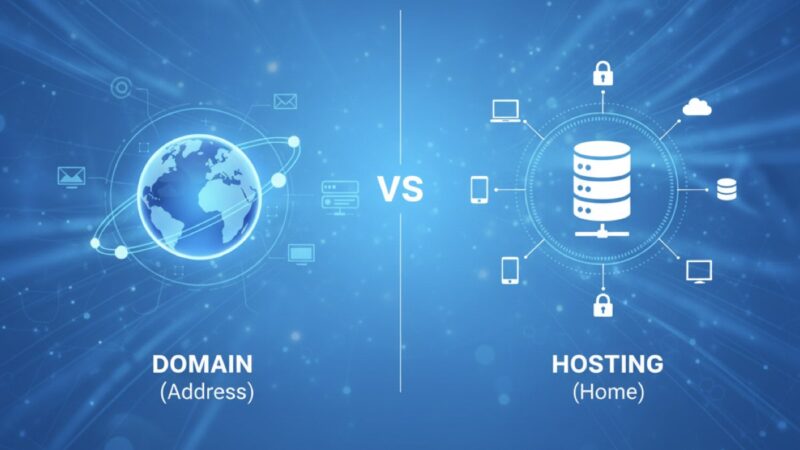
The Domain is your website’s online address, while Hosting is the space used to store the images, videos, and files on your site. To create a website, you first need to register a domain, and then order a hosting service.
What is a Domain?

A domain is a unique name used to identify your website on the internet. This allows users to find your site’s address online. For example, when you register a domain name like companyname.com or companyname.net, this domain provides you with a unique online identity and an easily memorable address for your web project.
A domain is the unique address of a website on the internet and consists of several parts separated by dots. The domain structure is organized according to a hierarchical principle. The basic elements of a domain include the following:
1. TLD — Top-Level Domain
The TLD is the part immediately following the last dot, on the far right of the domain. It determines the site’s category or geographical affiliation. There are a few basic types of Top-Level Domains:
- Generic Top-Level Domain (gTLD): Domain extensions that are not tied to a specific country and can be used for any site. For example, .com is used for commercial entities, .org for non-profit organizations, and .net for various internet projects.
- Country-Code Top-Level Domain (ccTLD): Specifies the country or region the site is affiliated with. For example: .uk — United Kingdom, .us — United States, .de — Germany, etc.
- Sponsored Top-Level Domain (sTLD): sTLDs are created for specific communities or organizations. For example, .gov is for government and administrative resources, or .edu for educational institutions.
2. Second-Level Domain (SLD)
The Second-Level Domain is located immediately before the Top-Level Domain (TLD) and usually represents the name of the site or brand. This part must be unique and reflect your purpose, ensuring users can easily recognize you. During domain registration, you should choose an SLD that is as simple and memorable as possible. Ideally, choose a short name without complex, hard-to-pronounce letter combinations.
3. Subdomain
A Subdomain is the name part located before the second-level domain. It can be used for different sections or services. For example, blog.companyname.com is used for the company blog, shop.companyname.com for the online store, or support.companyname.com for the support service. A TLD can be added or deleted as needed without having to register a new domain. If you own the second-level domain, you can create as many subdomains as you wish.
What is the Purpose of a Domain?
A domain is necessary so that users can easily find and visit a site on the internet. The main purposes of a domain include:
1. Easy Site Access
The domain replaces the complex IP address of the server where the site is located with an easy-to-remember and easy-to-type name. This makes visiting your site simple and intuitive for people.
2. Creating a Unique Name
Every domain is unique, which sets your site apart from others. If your domain name is already registered, for example, no one else can have the exact same one, guaranteeing the uniqueness of your web address.
3. Facilitating Marketing and Branding
A well-chosen domain helps promote your brand or business. An easy and memorable domain makes the site more recognizable and helps users find it faster.
4. Domain-Based Email
Domains are used not only for websites but also to create corporate or personal email addresses, which provides a professional appearance and earns customer trust.
5. Ensuring Security
Registering a domain prevents fraud and malicious use by others by preventing other individuals or companies from using your brand name.
What is Hosting?

Hosting is a service where your files and data are stored on an internet-connected server, making them accessible online. It is typically used to store a website, blog, or application on the internet so that users can access them at any time. Without hosting, your website would not be accessible online, and users would not be able to find your site. Therefore, if you want to create a site on WordPress or other platforms, you need to purchase a hosting service.
Technically, hosting provides the following:
- Space on the server to store website files
- 24/7 access to these files from the internet
- Technical support and data protection
What Are the Types of Hosting?
There are several basic types of hosting, each with its own specific features. To determine which hosting to choose for different tasks, you first need to assess your site’s needs, traffic expectations, and budget.
| Hosting Type | Description | Suitable For |
| Shared Hosting | One server is shared among many sites. | Small sites, blogs, informational websites. |
| VPS (Virtual Private Server) | You use a dedicated, isolated partition of a server with its own resources. | Medium-sized sites, e-commerce stores. |
| Dedicated Server | The entire physical server is exclusively for your use. | Large projects, high-traffic websites. |
| Cloud Hosting | Resources are distributed across multiple servers. | Projects with variable, fluctuating loads. |
For most small businesses, the most suitable choice will be Shared Hosting or VPS, depending on the site’s size and visitor count.
- Shared Hosting: The most affordable and popular type of hosting. Simply put, it is a single server shared by multiple users. The virtual partitions of this server are distributed to the accounts of several website owners, and several sites are hosted on it accordingly. Shared hosting is characterized by a small amount of space, low computational resource limits, and an affordable price. Despite its low specifications, it is the best option for most sites and the only correct type of hosting for beginners.
- Virtual Private Server (VPS): A more advanced type of hosting that provides more resources and server control. It offers higher performance, increased access, and is more expensive than Shared Hosting, but offers more possibilities. VPS is suitable for medium and large sites that require more power and flexibility.
- Dedicated Server: The most powerful and expensive type of hosting, where all server resources are provided to a single site. It allows you to achieve maximum performance and stability but also requires high costs for server maintenance and management.
- Cloud Hosting: A type of hosting that combines several servers into a single infrastructure. Cloud hosting allows resources to be scaled based on the load, ensuring high availability and reliability. It is suitable for sites with variable loads, such as news portals, blogs, and other projects that may experience peak loads at certain times.
Key Differences Between Domain and Hosting
Hosting provides space on a server to host your website files, while a domain provides a unique name to access your site over the internet. In other words, Hosting is the physical storage where your data is kept, and the Domain is the address where users can find your site.
The fundamental differences between these two concepts include:
| Criterion | Domain | Hosting |
| Definition | The name and address of your website on the internet. The part visitors type into the browser. | Physical or virtual server space where your website files, databases, and emails are stored. |
| Purpose | To identify your site and represent your brand. | To ensure your site is accessible 24/7 and to store content. |
| Changeability | Possible to change, but doing so resets your SEO ranking and requires re-optimization. | You can switch to another hosting provider anytime, with no negative impact on SEO. |
| SEO Impact | Domain change affects search engine rankings; the new domain requires at least 6 months of re-optimization. | If the migration is done correctly, changing the host has no direct negative impact on SEO. |
| Term / Renewal | Generally registered annually and must be renewed before expiration. | Leased monthly or annually; the service is suspended by the provider when the term expires. |
| Ownership | You have the rights to the name, but it is a rental/lease. If not renewed on time, someone else can register it. | You own the files, but the physical server is not yours. |
| Portability | The domain can be transferred to another registrar. | Site files can be moved to another hosting company. |
How to Choose Hosting and a Domain
When you plan to create a website, choosing the right hosting and domain is crucial for reliable operation and easy access for users. First, you need to perform some preliminary steps:
1. Site Type
Before starting to choose hosting and a domain, you need to decide what kind of site you will have. Will it be a small blog, an e-commerce store, or a large corporate site?
- For a small blog or low-traffic sites, Shared Hosting is sufficient. This is the simplest option.
- For e-commerce sites or high-traffic sites, VPS or Cloud options are more suitable, as they are more reliable and can handle significant loads.
- For a serious project involving large data volumes or complex applications, a Dedicated Server is the best solution.
2. Reliable Hosting Provider
There are many different providers offering hosting services on the market, and when making a selection, you need to pay attention to the following parameters:
- Speed and Reliability: Check how fast and stable the hosting service operates. Fast loading is essential, otherwise you may lose visitors.
- Technical Support: Check if the provider offers 24/7 support that quickly resolves all issues.
- Security: Be sure to check if the hosting service offers protection against cyber attacks and data backup services.
- Price: Compare prices and review what is included in the plan.
Fast Panda offers a high-performance hosting solution that meets all these criteria. With fast loading times, guaranteed uptime, a 24/7 technical support team, advanced security measures, and regular data backup service, your website will always be secure, fast, and accessible. Furthermore, the flexible pricing options allow you to easily find the solution that best fits your budget.
3. Domain Registration
Domain registration is done through a domain registrar, and the domain name you choose must be unique. This is because the correct domain choice is of great importance for both brand awareness and search engine visibility.
Fast Panda provides user-friendly search and filtering tools, a fast registration process, and affordable pricing options so you can choose the domain name that best suits your needs and target audience. This allows you to easily find the domain that best reflects your brand and complete your registration securely.
Affordable and Secure Domain Registration and Hosting Plans with Fast Panda
Choosing the right domain registration and hosting provider is critical for your website to run with high performance and be accessible at all times. Fast Panda, one of the most important names in the industry, allows you to securely manage your domain and hosting services from a single point and quickly launch your site with a professional infrastructure, backed by its 24/7 technical support team.
The hosting plans they offer ensure your website is always secure and fast with a high-performance SSD infrastructure, 99.9% uptime guarantee, advanced security measures, and regular backup service. They provide a suitable solution for every project with scalable plans for different needs, such as Shared, VPS, Cloud, and Dedicated.
You can securely register your domain among thousands of different extensions at the most affordable prices, and the user-friendly domain management panel allows you to easily manage the domain names you have registered.
In conclusion, choosing hosting and a domain is a critical step in creating a website. The most suitable solution depends on the type and scale of your project. Shared Hosting is suitable for small websites, while VPS or Cloud solutions are better for larger projects. When it comes to domain selection, it should be simple, memorable, and reflective of your business essence.